
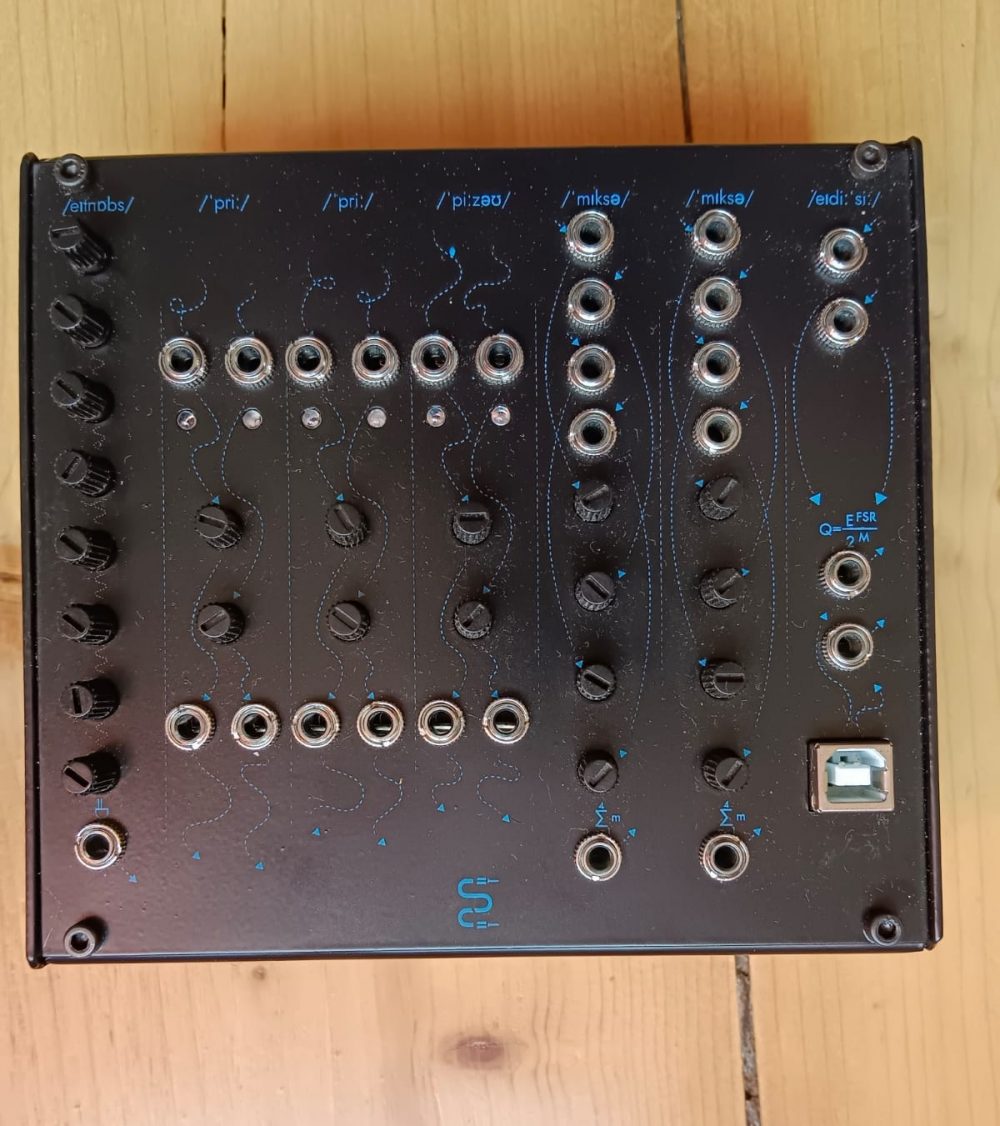
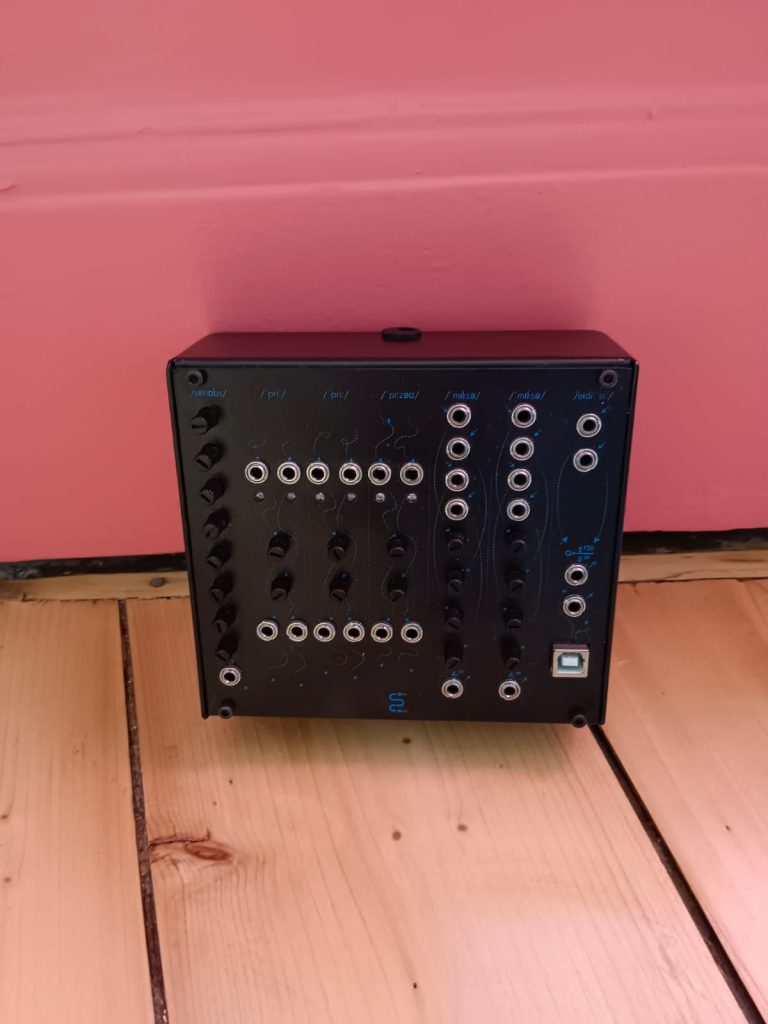
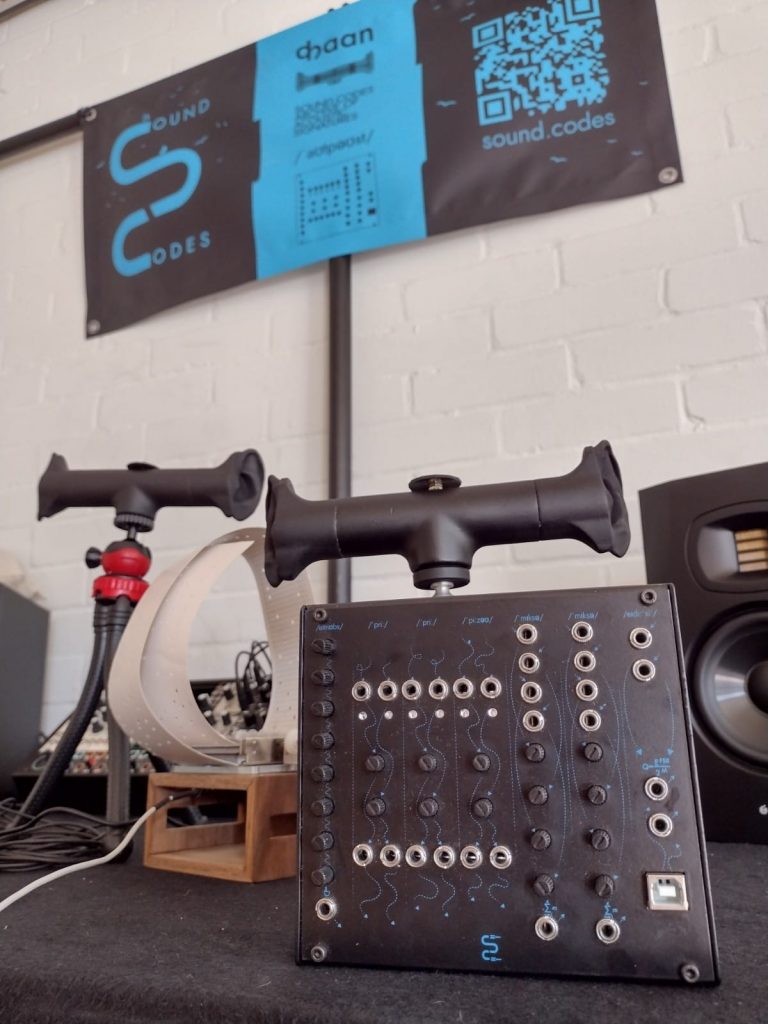
Archive. Outpost was a limited-edition exploration of an idea. No further units will be built; this page keeps a record of what it was.
Mix and manage multiple input and output devices and formats to record and track anything, anytime, anywhere, on your own. Outpost was made for creatives and sound and music professionals on the move, and worked just as well as a compact home studio.
It contains 8knobs, the sound.codes atmospheric drone generator, named for its eight oscillators that make pulsating, multi-harmonic drones. Four intelligent electret microphone inputs and two piezo inputs do impedance matching and pre-amplification. Use it for multi-channel live streams, plug it into single or multi-camera setups, or take it out for field recording.
Power it from 5 V USB, such as a power bank or phone charger, or from a 12 V DC adapter (not included). The free Outpost app turns your phone into a portable studio to record, store, share and manage recordings and their rights, including shared sessions over video call.
In the box
- 2 omnidirectional and 2 unidirectional electret microphones
- 2 Murata piezo transducers
- 1 EMF microphone
- USB A to B cable for the sound card
- USB 5 V to 12 V DC power cable
Listening in the field
Outpost grew out of years of recording heritage spaces and Himalayan villages, where the studio has to come along in a bag. Its inputs reflect three ways of listening. Electret microphones capture the air. Piezo transducers are contact microphones: pressed against wood, stone or metal, they pick up vibrations inside the material that you cannot hear in the room. The EMF microphone listens to electromagnetic fields, making the hum of chargers, cables and street lighting audible, an approach the artist Christina Kubisch has explored in her Electrical Walks.
The composer R. Murray Schafer and the World Soundscape Project in the 1970s argued that the sounds of a place are part of its identity and worth recording before they change. Outpost was built for that kind of listening, where every input is an attempt to hear a place more completely.
Why a drone
8knobs makes drones: long, slowly shifting tones built from eight oscillators. The drone is one of the oldest foundations of music, from the tanpura in Indian classical music to the work of La Monte Young, Éliane Radigue and Pauline Oliveros. A sustained tone gives the ear time to notice the beating between close frequencies and the harmonics that come and go, which is exactly what 8knobs lets you play with.
Further reading
- Schafer, R. M. (1977). The Tuning of the World. Knopf. (Republished as The Soundscape, 1994.)
- Kubisch, C. Electrical Walks, ongoing series. Link
- Oliveros, P. (2005). Deep Listening: A Composer’s Sound Practice. iUniverse.