
The Lost Party asked us for an interactive installation in their camping area that would let people jam with one another. We built Hexamix using SEMI and ATOM.
The table
Hexamix is a hexagonal table built from six trapezoidal segments around a central hexagon, one segment per player. The shape is a social decision as much as a structural one: nobody sits at the head of a hexagon, everyone faces the centre, and each player can see what the others are doing with their hands. That visibility is what lets strangers start jamming within minutes.
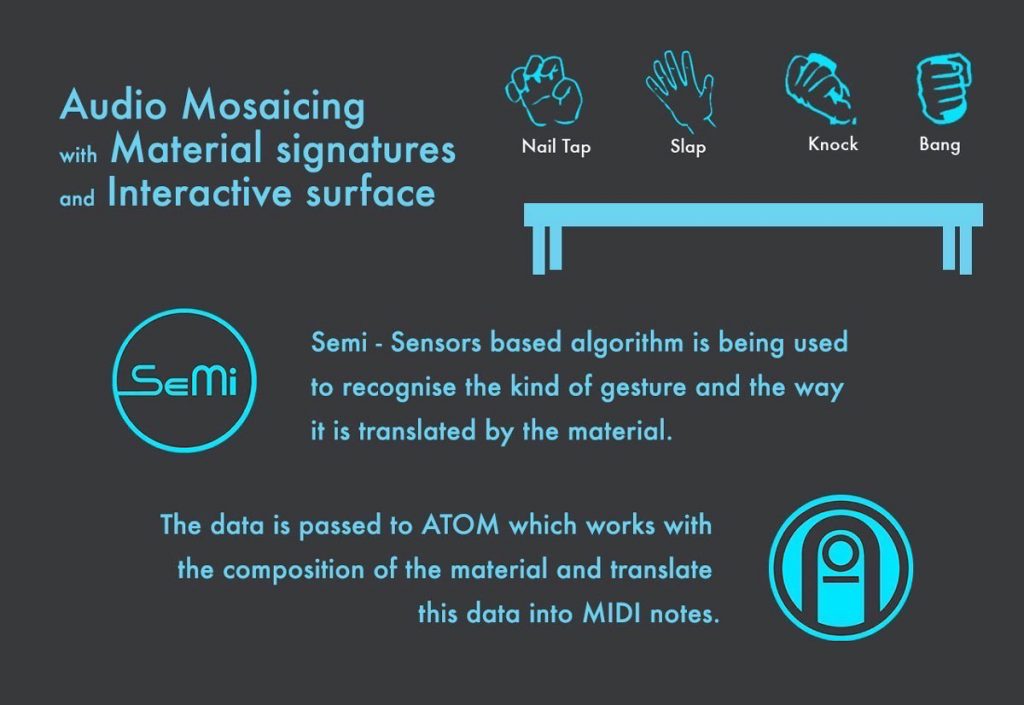
Each segment is a sensing surface. SEMI reads how it is touched (tapped, slapped, knocked, swept) and passes the gesture to ATOM, which turns it into MIDI. The approach grew out of our material signatures research: rather than triggering a fixed sample, the system picks short fragments of sound that match the character of each touch and strings them together, a technique known as audio mosaicing or concatenative synthesis.
Context
Shared tabletop instruments have a short but rich history. The reacTable, developed at Universitat Pompeu Fabra from 2003, showed how a round table with no front or back lets several performers build one piece of music together. Hexamix takes that idea out of the lab and into a festival campsite, with wood instead of a screen and touch instead of tokens.
References
- Jordà, S., Geiger, G., Alonso, M. & Kaltenbrunner, M. (2007). The reacTable: exploring the synergy between live music performance and tabletop tangible interfaces. Proceedings of TEI ’07, 139–146.
- Zils, A. & Pachet, F. (2001). Musical mosaicing. Proceedings of the COST G-6 Conference on Digital Audio Effects (DAFx-01), Limerick. Link
- Schwarz, D. (2006). Concatenative sound synthesis: the early years. Journal of New Music Research, 35(1), 3–22.
Have a space, a sound or an idea?
We design custom immersive experiences and tools for artists and businesses, and we’re always looking for spaces to listen to.
contact@sound.codes