Built for one place
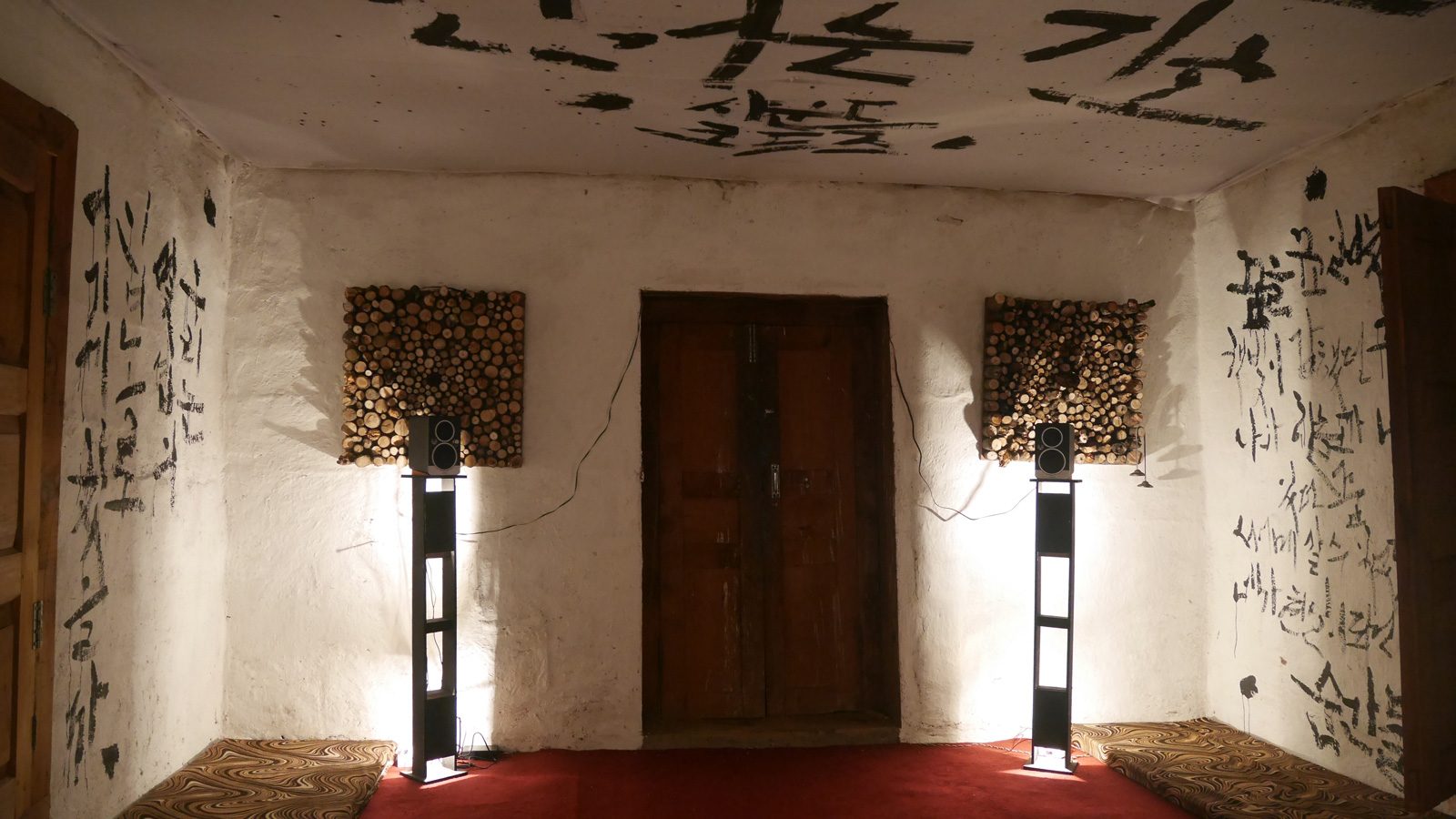
DroneKnobs is a site-specific instrument, made for our remote lab, KarmaQuad, in a Himalayan village at roughly 2,300 metres. Apart from the laser-cut steel shell and some of the electronics, everything in it was sourced in the hamlet itself.
An experiential interface
The panel has no labels and no indicators. Nothing tells you what a knob does; the only way to learn the instrument is to use it, spend time with it and get acquainted. It is learning by doing: the interface becomes familiar the way a place does, through time spent in it.
How it works
Information transmitted as experience, experience being the information: an informal way to communicate synthesis. DroneKnobs shows signal flow and how an enthusiast platform like Arduino can shape waveforms and envelopes in lo-fi 8-bit sound. It’s a panel of knobs oscillating in time; you dial in the position, controlling frequency or sending control changes.
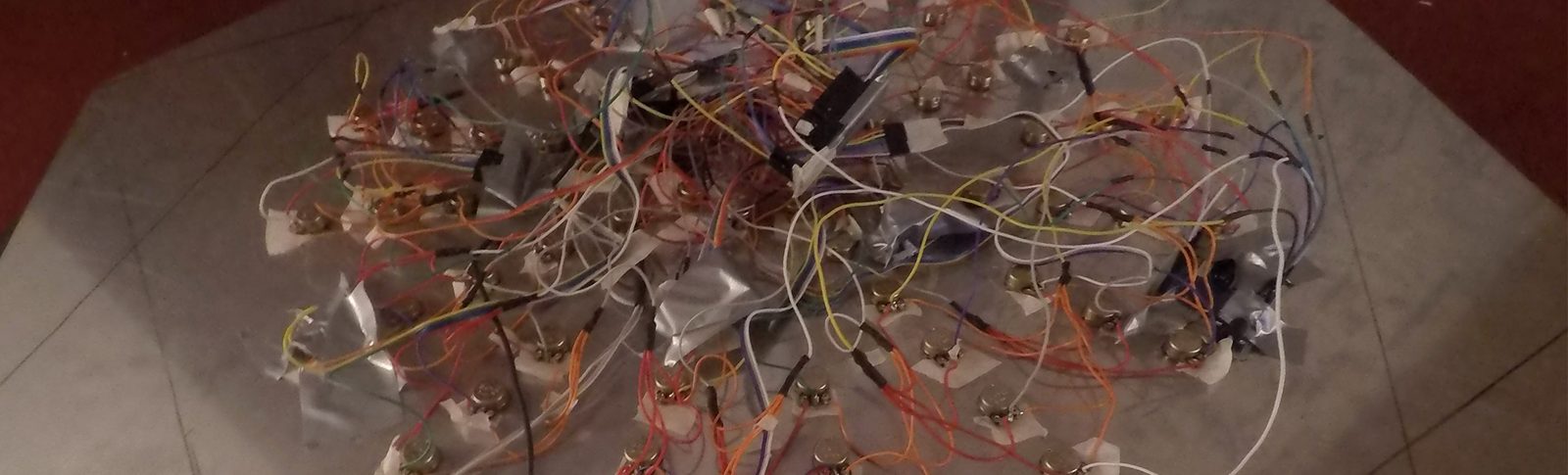
The build reads analog inputs through a 16-channel CD74HC4067 multiplexer to control oscillators and phase modulation, smoothing control signals at audio rate. It also uses AutoMap, which maps unpredictable inputs to a set range. A cosine wavetable gives a range of 8 Hz to 8,184 Hz, with control modulation from 0 to 127. The panel uses 3 Nanos with a mux, 3 Leonardos with 2 muxes, and one Uno.
- Audio output on digital pin 9
- Potentiometers on A1–A8, A10, A11
- MUX74HC4067: signal to A0, EN to pin 13, S0 to 11, S1 to 7, S2 to 5, S3 to 3
- Potentiometers on mux channels 0–9
- Audio output on digital pin 9
- Potentiometers on A1–A7
- MUX74HC4067: signal to A0, EN to pin 13, S0 to 11, S1 to 7, S2 to 5, S3 to 3
- Potentiometers on mux channels 0–9
- Audio output on digital pin 9
- Potentiometers on A1–A5
- MUX74HC4067: signal to A0, EN to pin 13, S0 to 11, S1 to 7, S2 to 5, S3 to 3
- Potentiometers on mux channels 0–9
Depends on Mozzi and CD74HC4067.
Under the hood
DroneKnobs runs on Mozzi, an open-source sound synthesis library for Arduino created by Tim Barrass, which lets a small microcontroller generate audio-rate signals. Phase modulation, one of the techniques DroneKnobs uses, is a close relative of the frequency modulation synthesis that John Chowning developed at Stanford in the late 1960s and published in 1973; it went on to power the Yamaha DX7, one of the best-selling synthesisers ever made. On DroneKnobs it is reduced to its essentials and put under your fingers: turn a knob and you hear new harmonics bloom out of a single tone.
Circuit, code and laser-cut design on GitHubFurther reading
Need something custom?
We build hardware for installations, performances and research. Tell us what you have in mind.
contact@sound.codes