
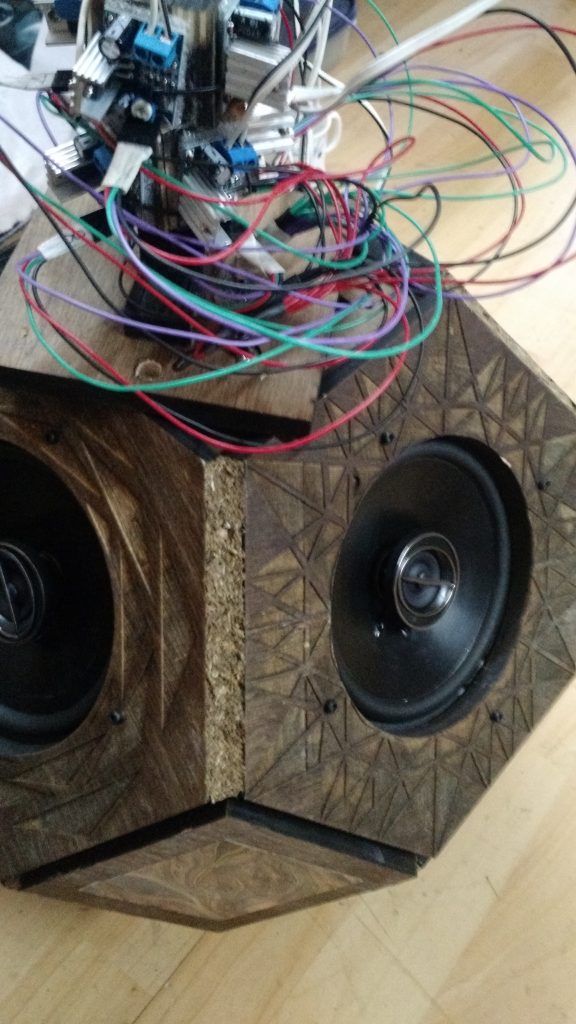
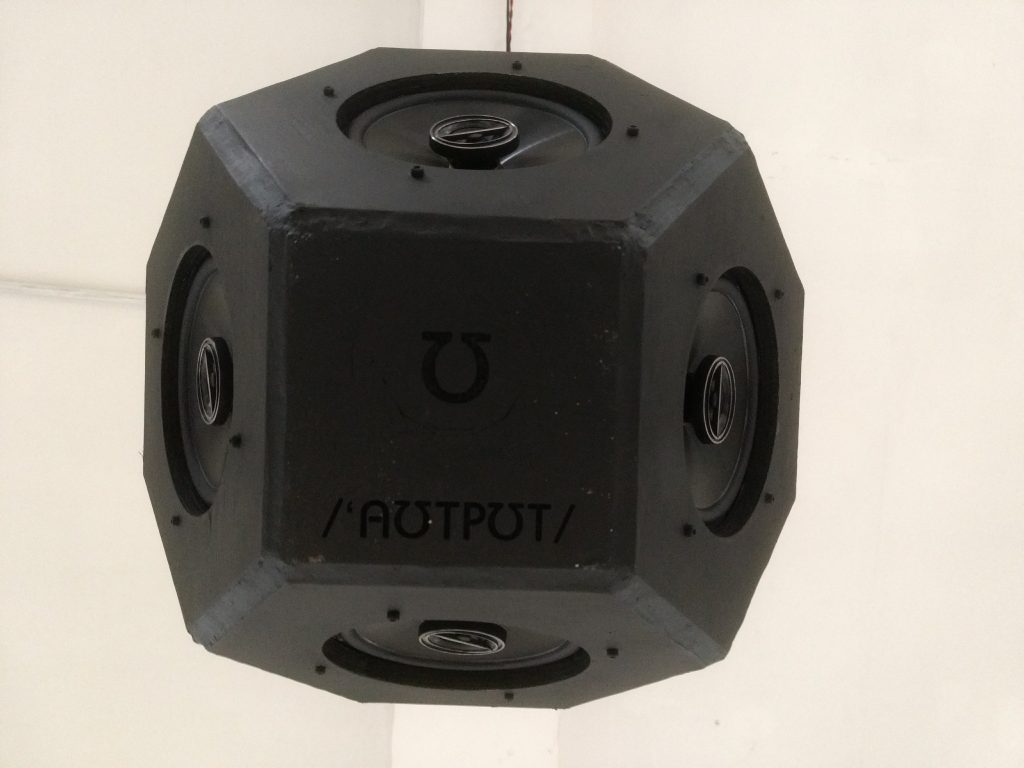
We built our first multi-directional speaker, designed as a truncated octahedron carrying eight speakers.
Why a multi-directional speaker
An ordinary loudspeaker sends most of its sound forward, in a beam. Acoustic instruments and voices don’t: a cello radiates differently in every direction, and the room fills in the rest. ˈaʊtpʊt (the name is the phonetic spelling of ‘output’) is a truncated octahedron, a solid with square and hexagonal faces, carrying eight drivers so that sound leaves it in every direction at once. It hangs in the room like an object rather than pointing at the audience like a screen.
The same idea runs through our archive work. To measure the acoustic signature of a room, the international standard ISO 3382-1 asks for a sound source that radiates as evenly as possible in all directions, typically a dodecahedron of twelve speakers. A source like ˈaʊtpʊt excites the whole room, not only the wall it faces.
Context
Composers have explored spherical and omnidirectional sound for decades, from the spherical German Pavilion designed with Karlheinz Stockhausen at Expo ’70 in Osaka to the hemispherical speakers built for the Princeton Laptop Orchestra in 2005, so each laptop could sound in the room like an acoustic instrument.
References
- ISO 3382-1:2009. Acoustics: Measurement of room acoustic parameters. Part 1: Performance spaces. International Organization for Standardization.
- Trueman, D., Cook, P., Smallwood, S. & Wang, G. (2006). PLOrk: The Princeton Laptop Orchestra, year 1. Proceedings of the International Computer Music Conference, New Orleans. Link
- Blesser, B. & Salter, L.-R. (2007). Spaces Speak, Are You Listening? MIT Press.
Have a space, a sound or an idea?
We design custom immersive experiences and tools for artists and businesses, and we’re always looking for spaces to listen to.
contact@sound.codes