
Archives
Every space has its own acoustic signature, shaped by its size, its architecture and what it’s built from. We record those signatures so heritage spaces can be heard, not only seen. These are the collections; archaeoacoustic conservation explains why and how we make them.
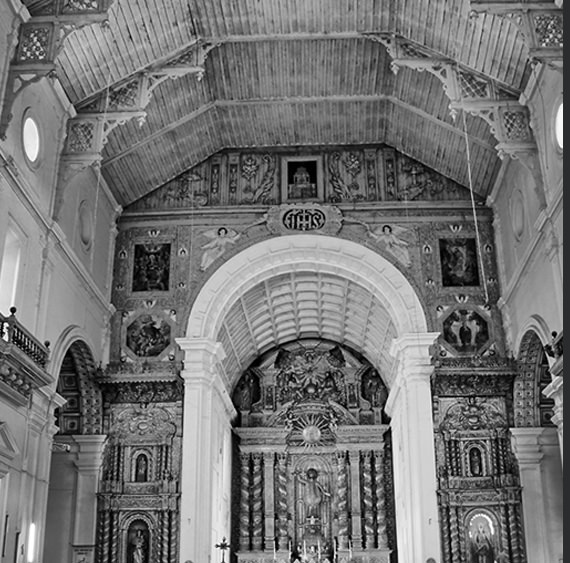
Goa
2000 BCE – 1900 CE, 23 spaces, recorded 2017Buddhist caves, Hemadpanti temples, mosques, Portuguese churches and forts, archived for the Story of Space festival.
Enter the listening room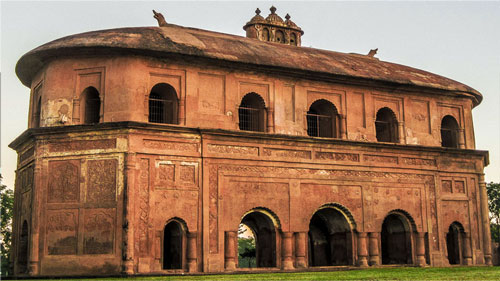
Ahom kingdom, Assam
1228 – 1826, Sibsagar, Assam, recorded 2014The amphitheatre of Rang Ghar, the underground Talatal Ghar and the temples of Sibsagar.
Enter the listening room
Victorian Bombay
Early 1900s, Mumbai, recorded 2014Theatres that became cinema halls, and a public hall that became a museum.
See the signaturesHow long each space rings
Reverberation time, Goa and Mumbai
- Aguada Fort, underground water tank, Goa14.74 s
- Corjuem fort, Goa7.43 s
- Our Lady of the Rosary, Goa5.03 s
- Sé Cathedral, Goa4.01 s
- Pilar mission seminary, Goa3.54 s
- Church of St Cajetan, Goa3.44 s
- Basilica of Bom Jesus, Goa3.23 s
- Our Lady of Penha de França, Goa2.89 s
- Pilar reconciliation chapel, Goa2.46 s
- Arvalem caves, Goa2.27 s
- São Jacinto lighthouse, Goa2.10 s
- São Jacinto church, Goa1.83 s
- Rivona cave 2, Goa1.59 s
- Cabo de Rama fort, Goa1.48 s
- Chapel of St Catherine, Goa1.37 s
- Shanta Durga temple, Goa1.23 s
- Safa Masjid, Goa0.96 s
- Tambdi Surla Mahadev, Goa0.86 s
- Kurdi Mahadev temple, Goa0.83 s
- Margaon cave, Goa0.74 s
- Namazgah, Goa0.74 s
- Rivona natural caves, Goa0.60 s
- Lamgau natural cave, Goa0.36 s
- New Empire, Mumbai2.13 s
- Edward Theatre, Mumbai2.70 s
- National Gallery of Modern Art, Mumbai13.93 s
A decade of listening
The archive spans caves, temples, forts, churches and theatres across India.
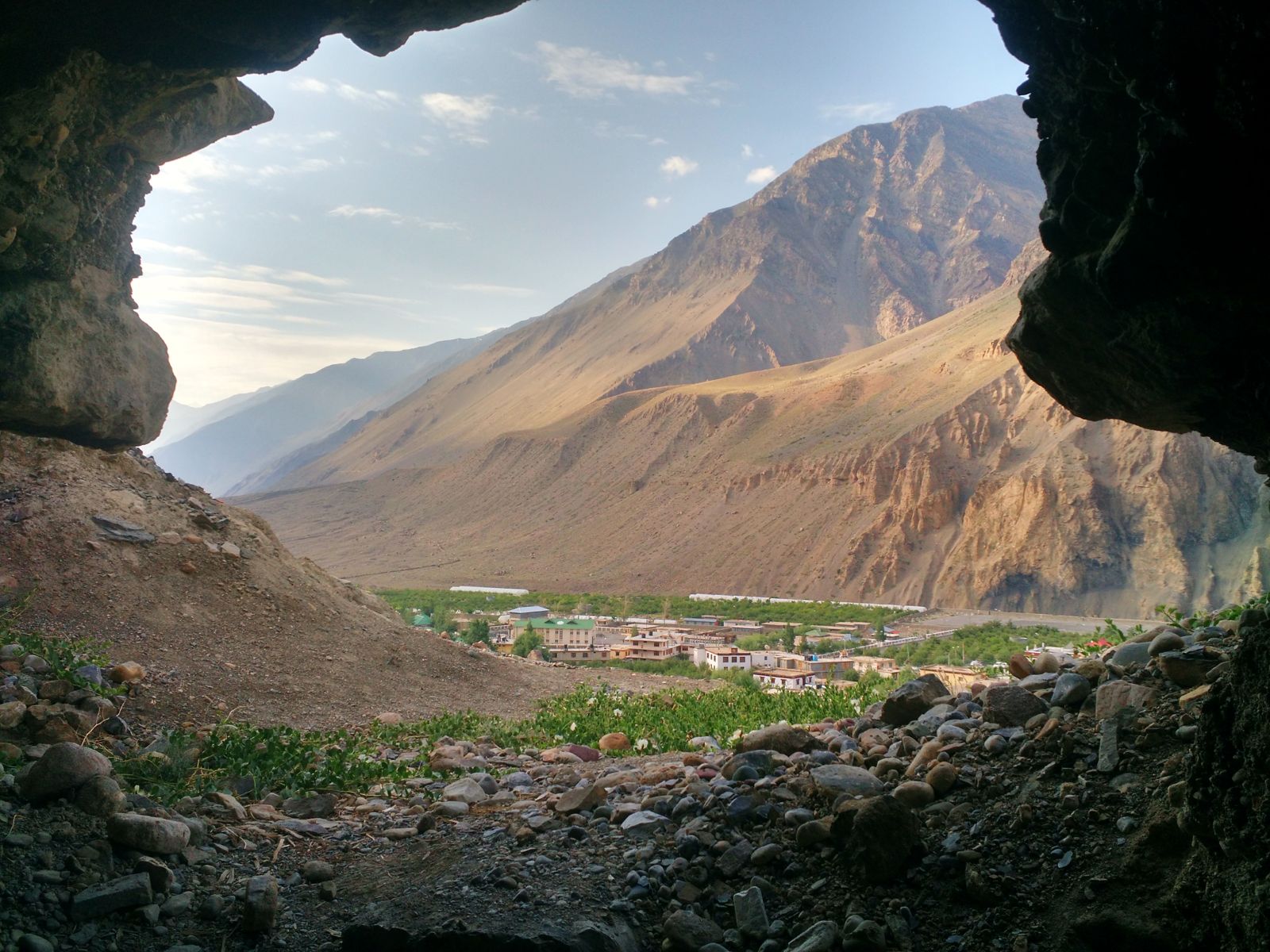
Tabo caves, Spiti
Tabo’s caves, along the course of the Spiti river, were used by hermits, monks and travellers. Most have eroded over time, leaving only a skeleton of the original spaces. In our analysis of the Tabo signatures we found that every chamber had its own natural resonant frequency, and staying inside one of the caves we could hear that resonance alongside the wind.
Acoustic Signatures Project
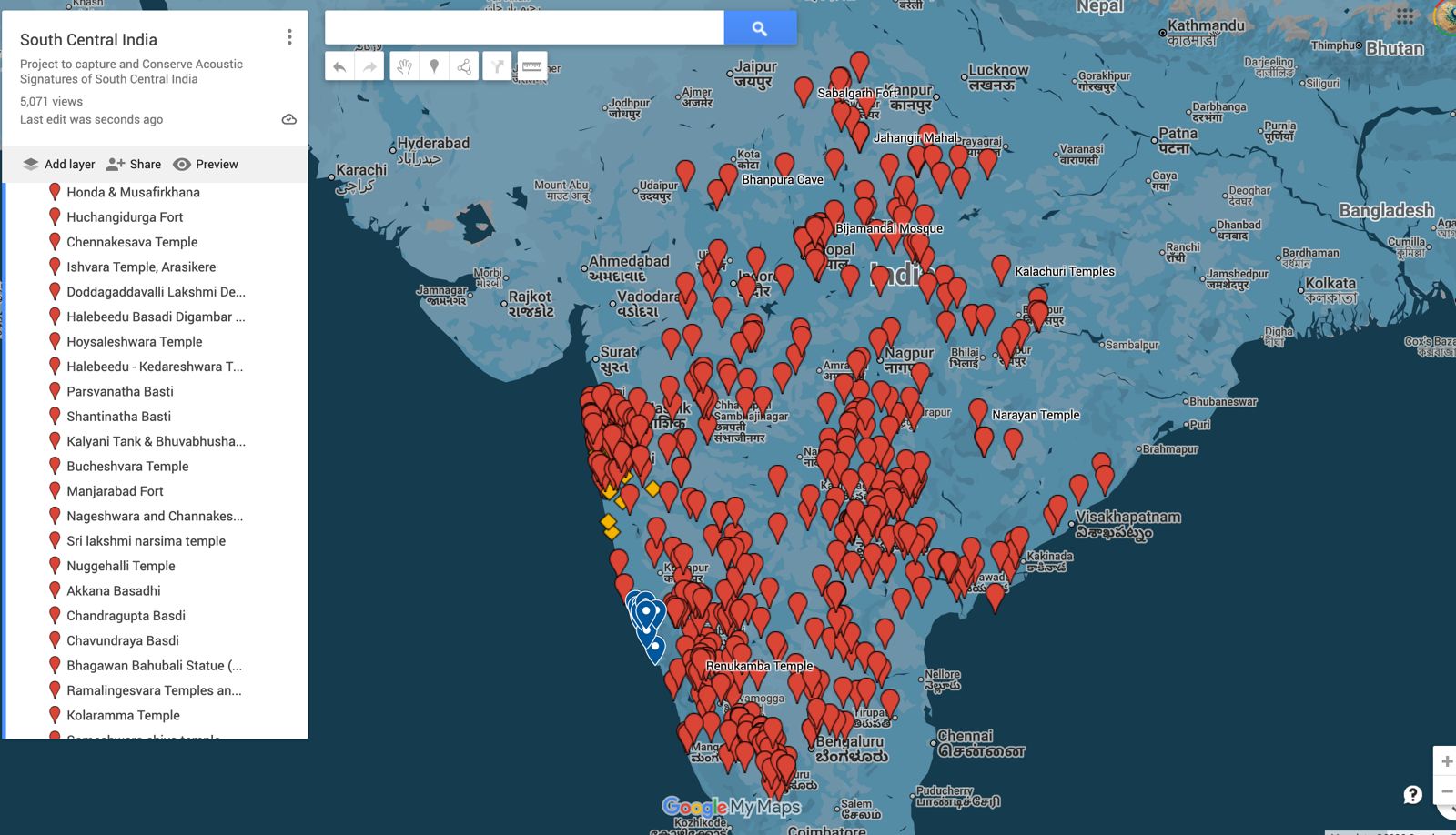
An ongoing project since 2016.
After three years of gathering data all over India, the focus is now South-Central India, especially spaces built under the Hoysala, Chalukya and Kalachuri dynasties. The aim is a comparative study of places of worship, caves, rock-cut architecture, forts and houses.
Further reading
- Murphy, D., Shelley, S., Foteinou, A., Brereton, J. & Daffern, H. (2017). Acoustic heritage and audio creativity: the creative application of sound in the representation, understanding and experience of past environments. Internet Archaeology, 44. Link
- Scarre, C. & Lawson, G. (eds.) (2006). Archaeoacoustics. McDonald Institute for Archaeological Research, Cambridge.
- Reznikoff, I. & Dauvois, M. (1988). La dimension sonore des grottes ornées. Bulletin de la Société préhistorique française, 85(8), 238–246. Link
- Fazenda, B., Scarre, C., Till, R. et al. (2017). Cave acoustics in prehistory: exploring the association of Palaeolithic visual motifs and acoustic response. Journal of the Acoustical Society of America, 142(3), 1332–1349. Link
- Blesser, B. & Salter, L.-R. (2007). Spaces Speak, Are You Listening? Experiencing Aural Architecture. MIT Press.
- Ong, W. J. (1982). Orality and Literacy: The Technologizing of the Word. Methuen.
Want to use these signatures?
We understand the possibilities of these acoustic signatures and are happy to help with your use case, from convolution reverbs to installations.
contact@sound.codes