
8knobs
A pocket synthesiser, a MIDI controller and a lesson in signal flow. Eight knobs, an Arduino and a jute case: right out of the box it makes drones and atmospheres.
8knobs is a portable synthesiser and MIDI controller. Built on the Arduino platform, it is open source and hacker friendly, ready to change with whoever is playing it: flash a new patch and the same eight knobs become a different instrument.
Plug it into a computer over USB and it is a class-compliant MIDI controller, with no drivers or converters. A 3.5 mm stereo jack sends MIDI to hardware synths, and a 3.5 mm mono jack carries audio out. Power it from USB, a 9–12 V DC adapter or a 9 V battery.
It comes as a DIY kit: a circuit board, an ATmega32u4 Arduino, eight potentiometers and every part you need, a laser-cut wood veneer body and a case of hand-stitched jute with raw unbleached cotton. Building it is how you learn it.
Play the drones
The hardware’s default patch, here in the page. Drag a knob up or down, scroll on it or use the arrow keys, and choose a space from our archive to hear it in. Headphones help.
Penha de França uses the impulse response we measured in the church. The other spaces are modelled from the reverb time we measured there: they share its length and decay, not its exact character.
Infinite melody
A second preset: shift registers clocked by noise, read through scales from ragas and maqams to gamelan, over a bed of drones. It never quite repeats. It runs live on sound.codes.
- 8 knobs clock, white↔pink, sensitivity, source, drone, key, range, cross FM
- 60+ scales Western modes, Indian thaats and ragas, Arabic maqam, Turkish makam, Japanese, gamelan
- Waterfall a live spectrogram behind the knobs
The art of signal flow
While building 8knobs you learn soldering, the fundamentals of sound synthesis, electronics and code, by following one signal from a knob to a speaker. Signals in the brain are interconnected and influence each other: neurons pass information in chemical and electrical forms and combine into endless thoughts, words and actions. In the same way, playing with signal flow in hardware, in software and in space, through acoustics, opens up endless creative expression. Whether you take it up as a hobby or as the start of something larger is up to you.
Patches
Drones
drones.inoThe default patch. Eight sine oscillators, one per knob. Each knob sets its sine’s pitch directly (the 10-bit reading × 8, so 0 to 8,184 Hz), and each sine breathes through its own slow volume LFO, from one swell every 2.3 seconds on knob 1 to one every 53 seconds on knob 3. Because the LFO rates share no simple ratio, the mix never repeats the same way twice.
Glass patch
glasspatch.inoEight control-rate oscillators set the volume of eight audio oscillators. One knob picks the notes, another sets a feedback amount, and the rest set the pulse rate of each voice, so chords shimmer apart and back together like rubbed glass. Built on Tim Barrass’s Mozzi examples.
Octakhopar
octakhopar.inoBlippy phase-modulation beats through Mozzi’s reverb tank, modified by Khoparzi from the Mozzi PhaseMod and ReverbTank examples. The knobs set the carrier, two modulation rates, the modulation width and the envelope rate.
MIDI shruti
midishruti.inoTurns 8knobs into a class-compliant USB MIDI controller. Each knob sends a control change, scaled for a shruti-box style software drone. Remove the scaling to send the full 0–127 range to any synth or DAW.
Why eight knobs
A knob is the oldest interface in electronic music and still one of the most honest. It has one dimension, it stays where you leave it, and it shows its state at a glance. 8knobs keeps that directness: in the drone patch each knob is wired to exactly one oscillator, with no menus or modes in between. Turn it and the pitch moves, now. David Wessel and Matthew Wright argued that this kind of immediacy is what makes an electronic instrument feel intimate, and that the gesture-to-sound delay should stay under about 10 ms, with jitter of no more than a millisecond, for a player to feel in control rather than to be steering a machine.1
Limiting the instrument is a design decision too. Thor Magnusson describes digital instruments as systems of constraints: the fewer controls a performer has, the more the music comes from exploring what those controls can do.2 Eight sines and eight knobs is a small world, small enough to learn by ear in an afternoon, and deep enough that the same eight dials keep finding new chords.
Drones, beating and the tanpura
Most of what 8knobs does comes from what happens between notes. Two sines a few hertz apart do not sound like two notes; they sound like one note that swells and fades as their waves move in and out of phase. Hermann von Helmholtz explained these beats in 1863 and showed that as they speed up they turn into roughness, the grain we hear as dissonance.3 Bring two knobs close and you can hear that happen, slowly, from pulse to shimmer to grit.
The drone is old in India. The tanpura holds a cloud of overtones under every raga, and C. V. Raman showed in 1921 that its curved bridge, the jawari, is what makes a plucked string sing with so many upper partials for so long.4 8knobs builds a drone the other way round, adding sine partials one knob at a time, so you can hear a timbre assembled from its parts. Pauline Oliveros’s Deep Listening practice treats this kind of sustained sound as a way to pay attention to a whole space, rather than to a melody.5
Infinite melody: shift registers and 1/f
The melody preset generates tunes that never quite repeat. It uses a shift register, a row of one-bit memory cells clocked along like beads on a string. Rob Hordijk’s rungler, in his Blippoo Box, fed one oscillator into a shift register clocked by another and read the bits back as stepped voltages, producing patterns that sit between order and chaos.6 Tom Whitwell’s Turing Machine module made a looping random shift register a staple of modular synthesis: a single knob decides how often a bit flips, sliding from a locked loop to constant change.7
Here, a comparator turns noise or an oscillator into bits, and six registers shift at rates weighted like pink, or 1/f, noise: the lowest bits change often, the highest rarely. In 1978 Richard Voss and John Clarke found that the fluctuations of pitch and loudness in music, from Bach to the Beatles, follow a 1/f spectrum, and that melodies generated from 1/f noise were heard as more musical than white noise, which sounds too random, or brown noise, which sounds too predictable.8 Martin Gardner popularised their result, and a simple dice method for making 1/f sequences, the same year.9 The white↔pink knob moves the melody along that line.
The bits are read through a scale, from Western modes to Indian thaats, Arabic maqam with quarter tones, Turkish makam on a 53-comma grid, Japanese and gamelan scales. The range knob grows the pool of notes in order of importance in that tradition, so the melody starts on Sa and its principal note before it is allowed to wander.
References
- Wessel, D. and Wright, M. (2002). Problems and prospects for intimate musical control of computers. Computer Music Journal 26(3), 11–22. Link
- Magnusson, T. (2010). Designing constraints: composing and performing with digital musical systems. Computer Music Journal 34(4), 62–73. Link
- Helmholtz, H. von (1863). On the Sensations of Tone as a Physiological Basis for the Theory of Music. Trans. A. J. Ellis, 1875. Longmans, Green. Link
- Raman, C. V. (1921). On some Indian stringed instruments. Proceedings of the Indian Association for the Cultivation of Science 7, 29–33. Link
- Oliveros, P. (2005). Deep Listening: A Composer’s Sound Practice. iUniverse.
- Hordijk, R. (2009). The Blippoo Box: a chaotic electronic music instrument, bent by design. Leonardo Music Journal 19, 35–43. Link
- Whitwell, T. (2012). Turing Machine: a random looping sequencer. Music Thing Modular. Link
- Voss, R. F. and Clarke, J. (1978). “1/f noise” in music: music from 1/f noise. Journal of the Acoustical Society of America 63(1), 258–263. Link
- Gardner, M. (1978). Mathematical games: white and brown music, fractal curves and one-over-f fluctuations. Scientific American 238(4), 16–32.
- Barrass, T. Mozzi: sound synthesis library for Arduino. Link
The DIY kit
Full assembly guide (PDF)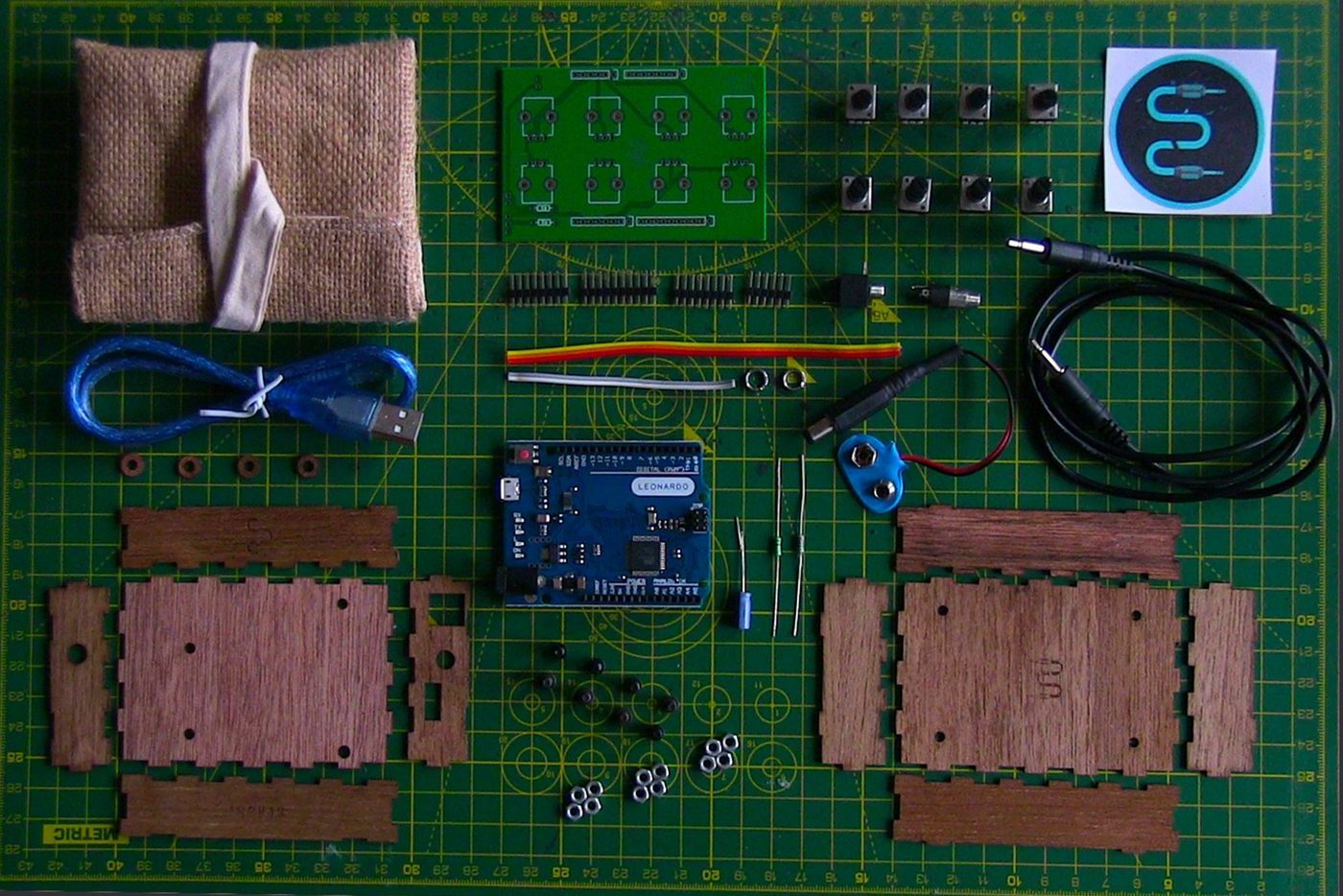
In the kit
- 8knobs circuit board
- 8 potentiometers
- 4 header pin strips
- 2 resistors and an electrolytic capacitor
- ATmega32u4 Arduino board (Leonardo)
- Mono audio connector and wire
- Stereo audio connector and wire (MIDI out)
- Laser-cut wood veneer enclosure with cover and washer
- 8 M3 hex bolts and 12 M3 nuts
- 9 V battery clip to DC cable
- Hand-stitched jute and cotton case
- sound.codes stickers
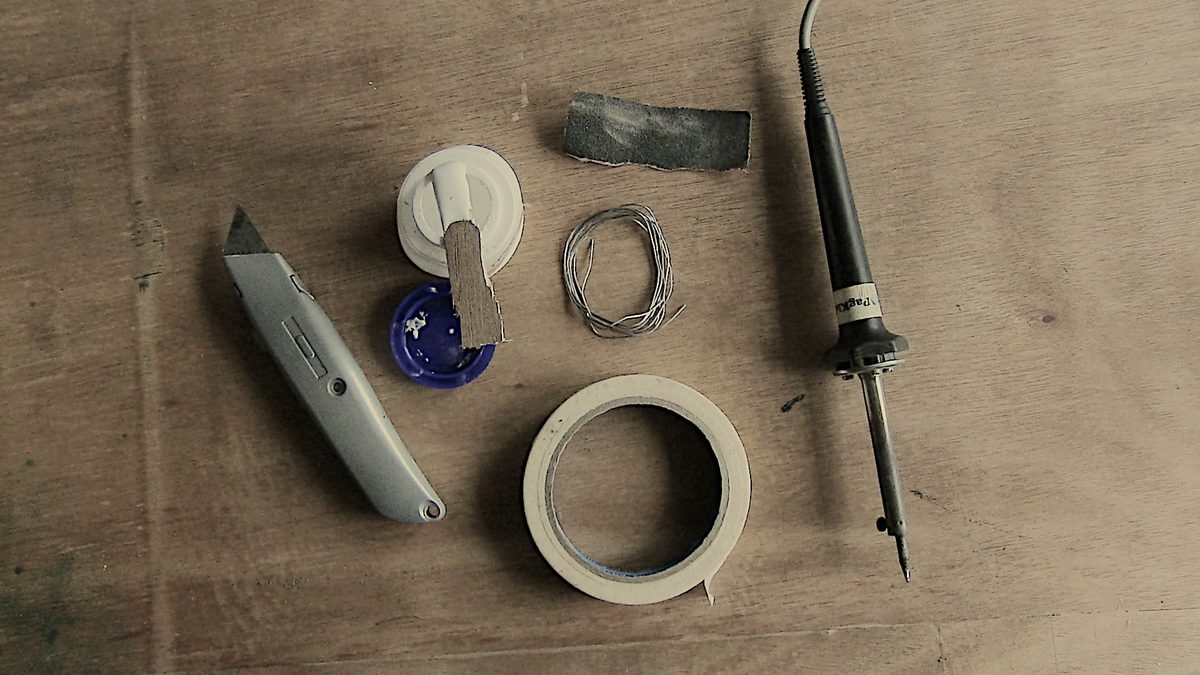
You’ll need
- Soldering iron
- Solder wire
- Paper or masking tape
- Cutter or wire cutter
- White glue
- Sandpaper
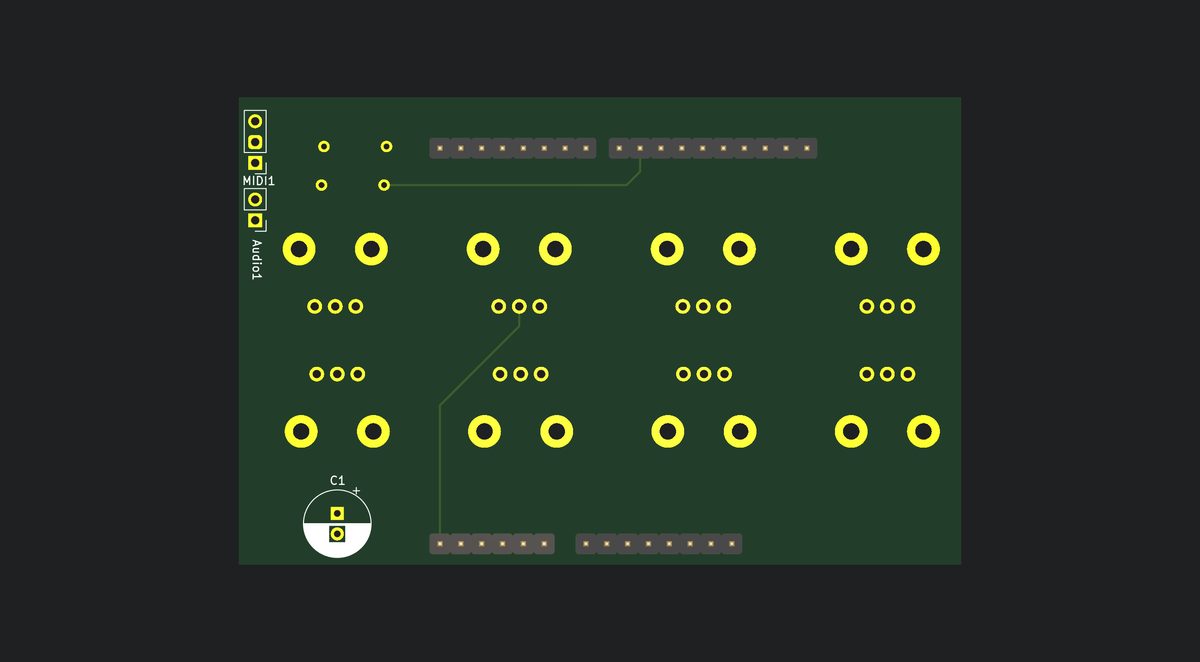
Assembly in eight steps
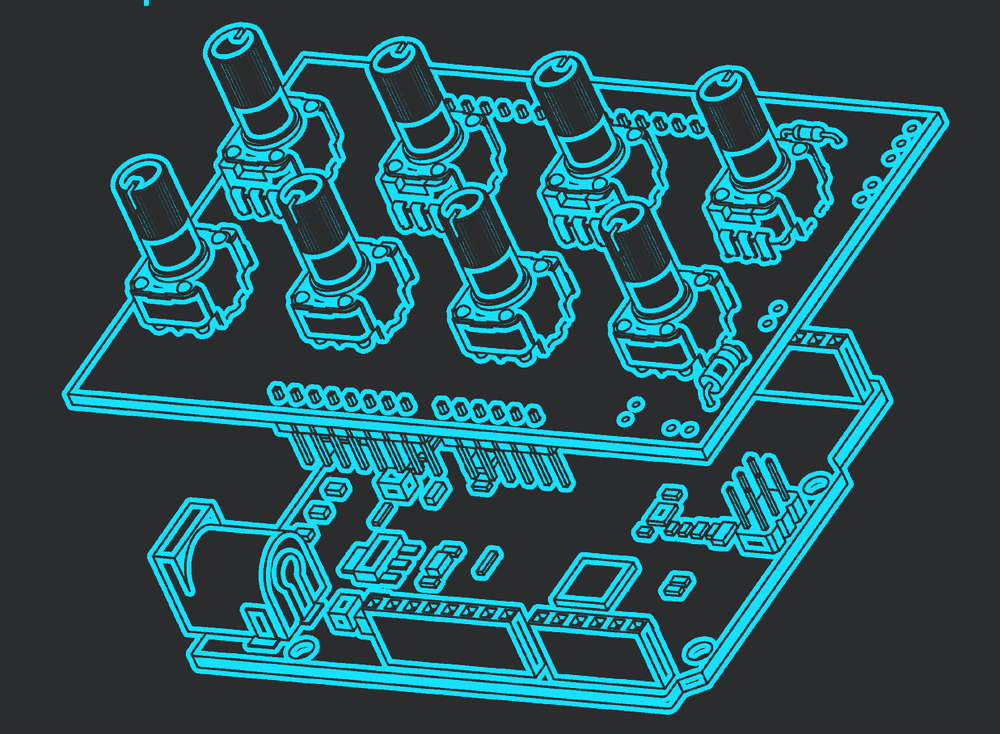
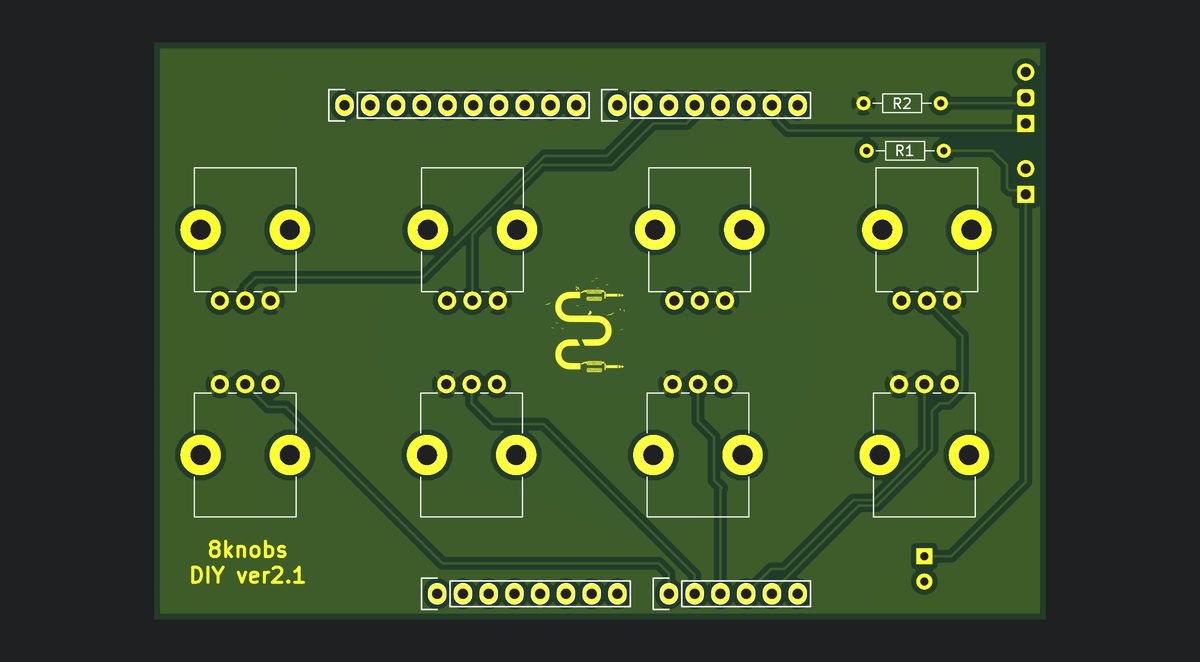
- Pots Snap the eight potentiometers into the front of the board and solder their support legs and three data legs from the back. Make sure no two joints touch.
- Headers Insert the header pins and solder them from the front. Tape or play dough holds them straight.
- Resistors Bend the legs of the two resistors (R1 and R2), place them on the marked positions and solder from the back.
- Capacitor On the capacitor, the short leg, on the white stripe, goes on the white half of the circle. Insert from the back, solder on the front.
- Audio out Solder the mono 3.5 mm connector’s wire to the signal and ground pads. It hangs loose until it is fixed to the panel.
- MIDI out Solder the stereo 3.5 mm connector’s tip, ring and ground for MIDI over TRS.
- Arduino Bolt the Arduino into the enclosure base through its mounting holes. Hand tight is enough, as long as nothing jitters.
- Stack Align the 8knobs board over the Arduino and press it home, centre first, then two diagonal corners at a time.
Then fix the jacks to the panel, close the enclosure and mark the bolt holes on the jute cover using the top panel. The guide on GitHub has a photo for every step.
Run an 8knobs workshop.
We run build-your-own-synth workshops for schools, colleges and studios. Write to us for kits or a session.
contact@sound.codes