
About
Sound.Codes is a sound research lab based in Mumbai and the Himalayas, founded by Akash Sharma.
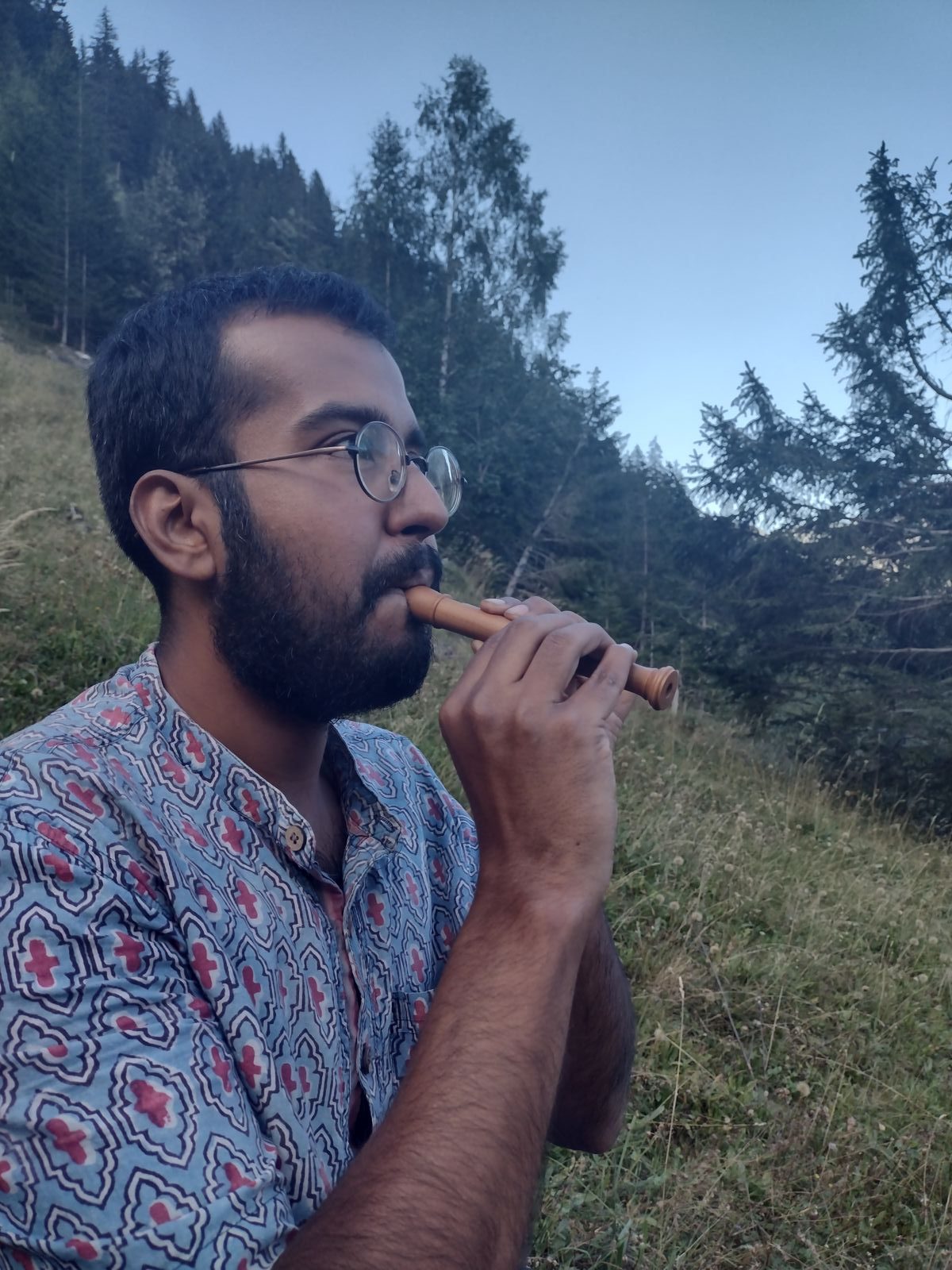
Akash Sharma is a sound artist, electronic musician and researcher whose practice bridges sound art, technology, perception and acoustic heritage. As founding director of sound.codes, his work spans electro-acoustic improvisation, algorithmic composition, sensor-based music, and long-term research into archaeoacoustics and indigenous knowledge systems. Drawing on backgrounds in computer science and music technology, his practice examines listening, human–machine relationships, and the translation of traditional sonic knowledge into contemporary electronic and computational frameworks.
One of our core missions is to advance acoustic heritage conservation by gathering and cataloguing the acoustic signatures of heritage buildings across India. To capture them, Sound.Codes developed its own version of convolution reverb, along with a binaural microphone, Kaan.
As an artist, Akash creates experiences through sound art, in installations and performances, and keeps finding new ways to bring music and technology together: experimenting with electronics and algorithms, and building hardware like a hackable synthesiser (8knobs) and portable modules to sample sounds in the field.
Sound.Codes is also committed to creative learning and a community sense of sharing knowledge, through workshops and curated seminars on electronics, sound synthesis and code.
“I see the space as a sphere for aural experimentation, to develop work in quadraphony and design immersive experiences.”
Akash, on KarmaQuad
Along the way
Akash’s ever-changing bio- 2013–14
- Spent five months with the Adi Minyon, a little-known tribe of Arunachal Pradesh in the remote Eastern Himalaya, researching and recording their traditions, rituals and customs, particularly tribal dance forms and disappearing folk tales.
- 2014
- Archived acoustic data of the Ahom civilisation in north-east India.
- Ended the year archiving the acoustics of Victorian-Saracenic buildings in Mumbai, and the city’s performance spaces that became cinema halls.
- 2015
- Started Music Tech Sundays and Sunday Evening Experiments.
- 2016
- Invited to an international panel of artists at the Carnival of e-Creativity, supported by the Government of Meghalaya and the Academy of Electronic Arts.
- Informal learning sessions on the physics of sound with school children across Himalayan villages.
- Ran Decoding Sound, a multi-city workshop series using Max/MSP.
- 2017
- Sonically archived ancient caves across Maharashtra, and every surviving structure built over 2,000 years by the Nizams, Marathas and Portuguese in Goa. The archive was shown as an open-access sound installation at the Story of Space festival, Fundação Oriente gallery, Goa.
- Resident artist at Karma Yatri Travel & Art (KYTA) in Kalga, building an open-source synthesiser, the KarmaQuad facility, an electronics lab in a box and a woodworking workshop, all open to the public.
- Part of S.T.E.A.M. School India, creating I See What You Say with Julien Deseigne and Sarah Bahr, later shown at UNESCO’s Tech2 conference in Visakhapatnam.
- 2018
- Archived sites of the Kalachuri dynasty in central India.
- Spoke on methodologies and experimentation in acoustic conservation at the Exploring the Edge conference, India International Centre, Delhi.
- Open Codes workshop and performance, Max Mueller Gallery, Goethe-Institut Mumbai (May).
- Archived ruins around the Lonar crater and surveyed the Ellora caves (June–August).
- Began SonicSkins with Sarah Bahr, an experimental performance using medical sensors to explore body and language through sound. It became the first project at KarmaQuad and toured Goethe-Instituts in Lyon, Cologne, Berlin and Stuttgart.
- Showed ‘I See What You Say’ in Lyon with Dr Julien Deseigne, Dr Gérald Gurtner and Démostalie, with a workshop at Labo NRV, Les Subsistances.
- Quadraphonic installation of the Goa archive at ERIAZO, Basel, and an open jam with UFO (Lukas Huber, Michael Anklin, Robert Torche).
- Designed an ambisonic room for sleep concerts at Serendipity Arts Festival, Goa, including a six-hour performance.
- 2019
- Exploring Sound, Visuals and Motion, India International Centre, Delhi (January).
- Talk on interfacing electronics with Ableton using Max at the Ableton User Session, Mumbai; Algorave India 2 at Goethe-Institut Mumbai; Reproduce Drones, Mumbai (February).
- SonicSkins second session at TIFA Working Studios, Pune, then Hyderabad and Bengaluru.
Today, Sound.Codes continues its long-standing work to preserve the acoustic signatures of historic and heritage spaces in India, and to find new ways to communicate, interact with and translate information through technology and electronics. Through talks and workshops we promote listening and an understanding of signal flow in electronics, physics and our own bodies, using heritage architecture to explore how environment shapes the self.
Say hello.
For commissions, collaborations, residencies at KarmaQuad, Kaan orders or archive requests, write to us.
contact@sound.codes